How to Hike with a Cracked Clavicle

April 25, 2017

Hiking while healing a broken bone is no joke.  It takes a great deal of energy to hike in the Appalachian Mountains, and it takes a great deal of energy to heal a bone.

Here are a few things to keep in mind when starting to hike with a cracked collarbone:

  • First, spend two weeks recuperating in a quiet place.
  • Second, find a hiking companion who will carry your food and community gear.  The term, ‘sherpa’, may or may not come up in the negotiations.  If you are lucky, the hiking companion is a much-loved husband (Jay) or wife or sister or brother or friend.
  • Third, find an engineer to redesign your pack with only one shoulder strap, preferably across your good shoulder.  Jay took the straps on my ArcHaul Zpack and rigged a y-shaped harness holding the pack onto my back.
  • Fourth, wear a really good sling.  I’m very grateful to my doctor for insisting upon an excellent sling for my arm.
  • Fifth, listen to your body.  The third week of healing, and simultaneously, the first week back hiking the AT, we only walked about eight miles a day.  I knew it was time to stop when the fire and brimstone would start glowing inside my broken bone, usually sometime during the last mile of each day.
  • Sixth, walk slowly, stopping often to admire the scenery.  Walk slowly, stopping often to talk to your sherpa, um, I mean loved hiking companion.  Walk slowly, stopping often to just sit and rest.  Walk slowly.
  • Finally, try not to gag when people on the trail say, “Oh, you’re so brave to be still out here hiking!”  I am not brave.  Bravery and courage happen when one takes action even though the action scares one silly.  Although there are scary situations on the AT, especially regarding weather, I do not see hiking with a half-healed clavicle as scary.  Perhaps I just have an astonishing lack of imagination.  So what adjectives describe hiking while healing?  Persistent – possibly.  Pig-headed – probably.  Set upon one course – certainly.  Obstinate – obviously.  But the adjective I like best was given by a local man walking his dog today.  “You are one determined woman!”  Yes, determined – definitely!

20170417_083535.jpg


P.S.  At all times, maintain a sense of humor!
20170421_144444
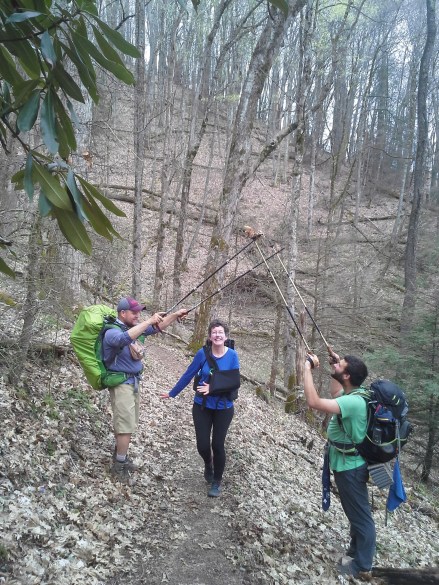
Houdini and Cashew make an arch of trekking poles as I process down the trail!

Persistent or Pig-headed?

April 23, 2017

While recuperating from my broken collarbone at Merchant’s Millpond State Park, Jay and I met a couple from Quebec. Robert and Liliana were camping from the back of a motorcycle, a feat which aroused my admiration. They, in turn, were intrigued with our goal of walking 2,000 miles from Georgia to Maine. We enjoyed a morning of conversation, with a smattering of French, lots of slowly spoken English, and a great deal of mime to help bridge the language challenge.

At one point our talk touched upon my broken collarbone, and my determination to continue hiking. Robert told me, “I don’t know the English words, but we say there is a fine line between ‘acharnement’ and ‘entetement’.”

That sparked a lively discussion as we endeavored to puzzle out the English equivalents. For ‘acharnement’, Robert came up with the cognate, ‘perseverance’, which led Jay to contribute the word ‘persistence’. As we wrestled with the word ‘entetement’, Jay and Robert thought perhaps the word ‘stubborn’ might be the translation, but was there a better word? Liliana and I looked at each other, and spoke on the same breath, “Pig-headed!”   “Tete de cochon,” Liliana added, laughing.

That conversation has stuck with me these past nine days as I hiked with my arm in a sling and only one usable shoulder strap on my pack. In order to finish 2,000+ miles in one hiker season, one MUST be persistent. But when does persistence change to pig-headed stubbornness? Many of my family and friends think I am risking too much by hiking after only two weeks of recuperation. And yet, I am following the collective knowledge of our years of hiking experience, and the wisdom of our doctor. (“Do I think you will spend the next weeks doing nothing? Not in a million years! Just limit your mobility, add activities slowly, the way I’ve shown you, and DON’T FALL!”)

Jay and I have hiked 85 miles in the past nine days, dawdling at viewpoints, ambling through flower-strewn forest, picking and eating ramps (a wild-growing Appalachian delicacy), and just taking our time. Daily my collarbone and shoulder have hurt less and become more mobile. It has been exciting to feel it healing while experiencing the beauty of spring and know I am still making small progress upon my self-imposed goal of hiking the AT.

So, to all my friends and family who have told me, “Be careful, be safe, take care, don’t risk,”… thank you from the bottom of my heart for your concern and love. I feel very lucky to have such caring people around me! However, I think of my last words with Liliana, and I know, “It’s time to CHOOSE LIFE!”

How to Heal a Cracked Clavicle?

April 9, 2017

  1. Leave the AT.   “If you fall, and jar all those little pieces apart, I can’t put it back together again,” your doctor warns.  Yes, leave the AT while healing.
  2. Steadfastly refuse to answer to the trail name, “Humpty Dumpty.”
  3. Emphatically refuse to take the pain medication prescribed by the doctor because you don’t like the way it steals your brain away.
  4. Complain about how much the broken bone hurts.
  5. Ask for help with every little task, including getting dressed. Wince and make faces of agony as your loved ones help you.
  6. Your husband gets fed up with all this. He rents a car and searches for a campground far away from the AT, somewhere exotic.  He finds Merchants Millpond State Park, very close to the Great Dismal Swamp of North Carolina.  “That has a nice ring to it!” he states, and makes a reservation.  When asked his thoughts, he explains, “I just wanted to leave the city.  I felt we needed to get some perspective on all this.  And if the campground is that bad, the AT will start looking pretty good!”
  7. Sit in the front seat of the car for the first three days at the campground. Try not to think of overstuffed recliners and bathrooms just down a hall.
  8. Realize that while you are camping, you don’t have to change your clothes, which is good for your shoulder.
  9. Eat lots of sardines and cheese for the omega-3s and the calcium. Hope it helps.
  10. On the fourth day at the campground, realize that the fire and brimstone in your shoulder is starting to die into smoldering embers, with only occasional flare-ups. Do the calculations, and realize that you have been living with this smashed bone for eleven days.
  11. Take a six mile easy hike, with backpacking gear in a fanny pack. The coals in your shoulder continue to glow, but no flames.  Happily begin planning your return to the AT.
  12. Realize that it is four more days until your follow-up doctor appointment. Try to enjoy the Great Dismal Swamp.
IMG_20170409_164531472_HDR
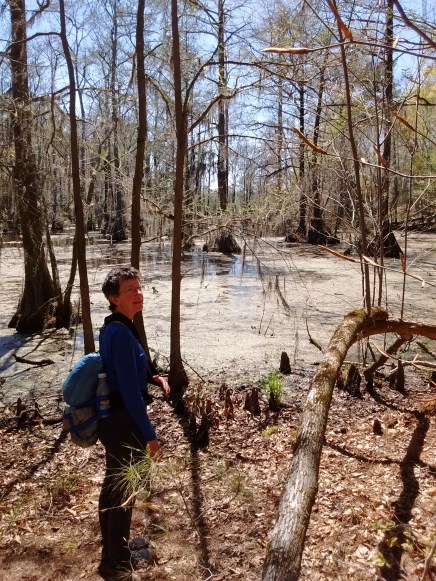
Sarah, roughing it at the Visitor’s Center at Merchants Millpond State Park.
IMG_20170409_134738898
Next stop, the Appalachian Trail!