Blog

Shaking the Mile Monkey

June 28, 2017

We have a mile monkey riding Jay’s shoulder.  Dressed in jockey attire, this little guy constantly urges Jay forward, ready to ignore all distractions such as gorgeous views, side trips to ice cream, bird songs, beautiful flowers, or even intimidating thunderheads.  A mile monkey has tunnel vision, choosing the straight and narrow of the trail over all diversions.  At the end of the day, his only interest is the number of miles completed.

My job is to frustrate this mile monkey.  I’m pretty good at this duty!  I’ve had many tiny imaginary monkey expletives hurled at my head during the past four months, as we stopped to swing on a vine, climb a boulder, take in a view, or … go off trail to attend a family reunion!

From Pine Grove Furnace State Park, near the halfway point of the AT, Jay and I rented a car and drove to Tennessee for a yearly gathering of parents, siblings, aunts, uncles, and cousins.  I’m afraid my motives for this trip were not purely based on family loyalty.  After hiking 1,102 miles, the thought of clean sheets and daily showers for a week were nearly as big an attraction to me as seeing loved kinfolk!

“No!” the mile monkey howled.  “How can you do this?  What kind of a thru-hiker are you?  Stop!  Go back!  Stay on the trail!”

The Appalachian Trail Conservancy defines a thru-hike as completion of the whole 2,190 miles of trail within one year.  Traditionally, hikers head either northbound from Georgia or southbound from Maine.  However, a hiker’s itinerary can begin anywhere along the trail.  Whether one “flip-flops”, “leapfrogs”, or does a “wrap-around”, the thru-hike challenge is to finish within a year.

“That’s not good enough!” the mile monkey chittered as it jumped up and down upon Jay’s shoulder.  “You started out northbound!  You’ve got to keep going!  You’ll never get to Mt. Katahdin at this rate!”

“Perhaps you’re right,” I addressed the mile monkey seriously.  “I began this hike as a bit of a pilgrimage, walking through spring like Earl Schaffer (first AT thru-hiker).  But with all our delays, most notably the month on and off trail, healing my broken collarbone, I’m not sure we can get to the end before Baxter State Park closes Mt. Katahdin on October 15.”

“Do you want to quit?” Jay entered the conversation.

“No way!”  My response was immediate, from my gut.  “We committed to a thru-hike!  I want to complete it!”

“What if we do a flip-flop?”  Jay mused.  “We could use the family reunion as a natural break.  Instead of getting back on the trail in Pennsylvania, we could drive to Maine, climb Katahdin, then hike south!”

“That’s it!”  I hugged Jay ecstatically.  “We hiked Georgia in winter, walked in awe through spring in North Carolina, Tennessee, and Virginia, now we can have summer in the north woods!  There will be no time limit on our finish as we hike south through the fall!”  I eyed the monkey triumphantly.  “Oh boy, mile monkey, you’re gonna have a tough time, now!”

“Agh!”  the mile monkey stomped in frustration.  “You haven’t heard the last from me!  I’ll find some way to keep nagging you!”

IMG_20170617_194723171
This rock was found on a cairn near the Mason-Dixon Line on the Appalachian Trail.


The Half-gallon Challenge

June 20, 2017

Hikers enter Pine Grove Furnace State Park just a few miles past the halfway point on the Appalachian Trail.  This beautiful setting is home to the Appalachian Trail Museum (a museum dedicated solely to hiking!), a self-guided historical trail (Pine Grove Iron Furnace built in 1764!), Fuller Lake (swimming and showers!), and incredible bird habitat (160 species of birds!).

But the one feature of the park that occupies the thoughts of many AT hikers is the Pine Grove Furnace General Store, home of the half-gallon challenge.  Here, time honored tradition compels scores of hikers to gladly pay $10 for the privilege of making themselves half sick from eating a half-gallon of ice cream.  If successful, the sugar-bloated hiker wins a tiny wooden spoon with the half-gallon challenge logo stamped upon it.

I must admit, Jay and I talked and dreamed of this indulgence for many miles.  On those hot, humid days, I was convinced I could demolish a half-gallon of ice cream with ease.  Fortunately for my blood sugar, the thunderstorm the previous day had broken the heat, and drowned my dreams of sweet indulgence.  By the time we arrived at Pine Grove Furnace General Store, the hiker burger held more attraction than two quarts of frozen confection.  (The hiker burger consists of a quarter pound beef topped with double cheese, egg, avocado, mushroom, grilled onion, tomato, and lettuce.  Yum!)

Another hiker, Dundee, had dreams made of sterner fiber.  Jay and I enjoyed watching him attack the half-gallon challenge.

Dundee chose vanilla for the first quart and a half.  He told us it was easier to eat ice cream without extra fillers such as nuts or fruit.  The first quart went down pretty fast, but his rate of consumption slowed during the next pint.  “This is beginning to affect my brain,” he told us.

“Oh boy,” we teased.  “The moment of truth has arrived.  We could ask you anything, and you’d reply.  You’re ready to reveal your deepest, darkest fear!”

“Ice cream,” Dundee mumbled.  “I’m scared of ice cream.  I can see it now, the torturer bringing me a pint.  I’d be moaning, ‘No, no!  I’ll tell all!  Just don’t make me eat that!’  Anything but this stuff!”  He dug out another reluctant spoonful and looked at it mournfully.

Dundee got to choose different flavors for the last pint.  By now, thoroughly sick of vanilla, he choose chocolate, topped with a dollop of moose tracks.  The first few spoonfuls were obviously delicious, then the tempo of ingestion slowed to a snail’s pace.  “Oh man,” Dundee whimpered, “chocolate was a mistake.”

“What’s wrong?” we asked.  “Don’t you like the taste?”

“Oh yeah, it’s good and all.  Just rich.  Way.  Too. Rich.”  Dundee grimly scooped another blob of the umber confection.

With a great deal of determination, the cup of chocolate was finally emptied.  Dundee threw it away, then waddled off to claim his tiny wooden spoon.  He returned to proudly show us his trophy, then collapsed into a chair as sugar took free rein over his body.

Another hiker, Blue Deer, arrived with ice cream on his mind.   He paid his $10, and brought the first quart and a half outside on the front porch.  “Hey, Dundee, I’ve got Neapolitan!  I won’t get sick of the vanilla taste this way,” Blue Deer gloated.

“Take my recommendation.  Eat the chocolate first,” Dundee groaned.

“I’ve hiked one thousand one hundred miles without your counsel.  What makes you think I need your advice now?” Blue Deer teased.

“Experience,” Dundee sighed as his head went down to the table.


 From beginning to end!  Half-gallon challenge!!


A Series of Moments

A description of separate moments from the last ten days of hiking:

June 11, 2017

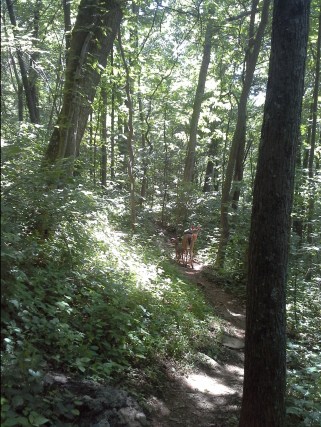
This morning we left Front Royal, VA, hiking into a green tunnel of beauty.  A couple miles into the day, Jay and I came around a bend in the trail, to see a doe calmly grazing.  A fawn looked out from under his mother’s belly, peering at us from between her back legs.  The doe turned her head toward us, took a few steps away, then continued grazing.  The fawn butted his mother’s side, and the doe walked a bit further down the trail.  We followed slowly, wondering if we could get a picture.  This continued for several minutes, the doe and fawn always several yards in front of us, but staying on the trail.

Finally, through the trees, we heard a noisy group of hikers approaching from the north.  The doe decided she’d had enough, between our quiet stalking and the chatter of a larger group.  She lifted her head, and took off eastbound through the trees.  Only problem was, the fawn ran west!  After a few moments, the doe appeared back on the trail, looked at us in indecision, then followed her fawn.  A few seconds later, they made one last appearance, now both headed east together.  Hurray!

20170611_111601
Stalking an unconcerned doe and her fawn.

Later today we came across a hiker feast – mulberries, wild strawberries, and black raspberries – all ripe!  We paused several times to pick handfuls.  Yum!


June 12, 2017

A very hot and humid day.  Yesterday Jay tried keeping cool by laying in a creek.  Today we decided to take a two hour siesta at Rod Hollow Shelter.  The shelter and privy were very clean, the grounds very shady.  It was lovely to lay on flat boards, with no bugs biting, a small breeze occasionally cooling our skin.  Yes, life is good on the AT!

We passed 1,000 miles today!  Hard to believe I have hiked that far!

IMG_20170612_194410391

June 13, 2017

Another hot, muggy day.  We reached the David Lesser Memorial Shelter in the heat of the evening.  Our skin felt covered in about four layers of sweat and insect repellent.  We took our water bottles half mile downhill to a lovely cold spring, filled them up, then walked a good ways from the spring and took a shower using our water bottles.  Aahh, what luxury!

June 16, 2017

Today the trail came to the Washington Monument.  Not the monument in Washington D.C.  This Washington Monument was built in 1827 by citizens of Boonsboro, MD.  On July 4, over 500 people marched from the public square for two miles up the mountain to create the first stone monument to George Washington.  What a way to celebrate our nation’s holiday!  The forty foot tall observation deck is reached by a circular staircase through the center of the tower.  I felt I was climbing inside a medieval castle as I ascended the wedge-shaped stairs!

20170616_105509

June 17, 2017

This evening Jay and I crossed the Mason-Dixon line!  We’ve left the southern Appalachians behind, and are now officially in the mid-Atlantic states!  We camped just a mile further, beside Falls Creek.

IMG_20170617_194705936


June 18, 2017

The most notable event on this hot and humid day was our stop at Deer Lick Shelter.  Inside the privy, Jay saw a HUGE spider!  About the size of my palm, it lurked high on the privy wall, waiting for its prey.  Yikes!

20170618_100036

June 19, 2017

At 12:45 p.m., the stifling humid heat finally broke with a roar and a bang!  Lightning flashed, thunder boomed, rain poured in sheets!  Within a matter of minutes, the trail transformed into a small creek.  Though we didn’t mind walking through rain, or splashing along a trail posing as a creek, the lightning did make us nervous.  It seemed rather dangerous to be ankle deep in water as lightning sparked all around.  So we stopped at the first semi-flat clearing in the woods and set up our tent as the rain poured.  Today’s two hour siesta happened inside our tent, listening to the splatter of raindrops and waiting for the thunderstorm to pass!

Once the storm was over, we emerged from our flimsy shelter, packed up, and kept on hiking.  About dinner time, we came to the official half-way point of the AT!  What a milestone!

IMG_20170619_182535660
We’ve done it! 1,100 miles!

Protecting Food

June 7, 2017

“How do you keep your food safe from bears?”  The day hiker has an intensely interested look as she asks me that oft-heard question.

Well, there are many answers…

First of all, I’m more afraid of marauding mice, squirrels, and raccoons.  Bears are not encountered very often, and problem bears are reported quickly.  It’s the little guys one has to watch for daily!  A mouse once chewed a hole in my backpack in broad daylight, with about eight people standing around talking!  Rodents know no fear.

However, if a hungry bear does come along, it is tough to completely protect a food bag.  Bears are as smart as humans, and much stronger.  The only thing we have going for us is a superior knowledge of technology.

So… four ways to protect a food bag.

Bear Vault

Some hikers carry a plastic canister designed to keep all wildlife out.  This works very well, and can also double as a stool in camp.  However, it is heavy and bulky.  I’m sorry to say that Jay and I are too lazy to carry it often, and we have not carried it on this AT hike at all.  (Yosemite requires the use of bear vaults, and we carry ours when we camp there.)

500

Bear Resistant Food Storage Locker

A bear locker is a heavy steel box with a door latch that is physically impossible for bear claws to manipulate.    Provided by the US Forest Service, the box is usually cemented to the ground.  This is the only sure way to protect one’s food.  It is also rodent proof, which, in my eyes, elevates it to a wonder box.  Unfortunately, only a few shelters on the AT have this storage container available.  I use it whenever I camp near one.

index

Bear Pole

A bear pole consists of a tall metal pole with y-shaped arms supporting hooks at the top, and a long metal rod with a hook on the end.  One puts one’s food bag on the hooked rod, lifts the bag high in the air, and loops it over a hook at the top of the pole.  This keeps it safe from bears.  It also keeps it safe from mice, short hikers, and hikers who don’t have much upper body strength.  It is a challenge to lift a fully loaded food bag with a long metal rod and have any control over it!

However, a ridge runner told us that a particularly athletic raccoon at Rock Springs Hut in the Shenandoah National Park had learned to jump and climb the bear pole, thus earning itself a hiker-sized feast each evening!  She recommended using the bear locker provided at that hut.

Last night, we camped at Rock Springs Hut.  I duly repeated the ridge runner’s advice and warning to the other five hikers there.  One other hiker used the bear locker with us.  Three hikers chose to sleep with their food.  (This is NOT EVER recommended, but hikers do it nevertheless.)  One hiker hung his food on the bear pole.

At 4:30 a.m., we all heard the clank of an animal messing with the bear pole.  At 6:00 a.m., the hapless hiker saw his shredded food bag and the remains of his food on the ground around the pole.  Rocky the Raccoon had struck again!

When I asked the hiker why he had used the bear pole, he said, “Well, it worked for the last four days at other shelters.  I figured nothing could actually climb it!”

I guess some people learn from their own mistakes, and some learn from other people’s mistakes.

IMG_20170603_064756146
Bear pole with many hiker food bags at Calf Mountain Shelter.

Tree Branch and Rope

This method is the most easily accessible to all kinds of wildlife, and yet it is the method we still use 85% of the hike.  When camping away from shelters, or even at shelters which have no food storage method available, a rope and a high tree branch are the next best options.

I have to admit, I enjoy tossing a half-filled water bottle connected to a rope over a tree branch, then hoisting our food bags aloft.  Sometimes it is a challenge to find an appropriate tree branch, and sometimes it is a challenge to get the rope exactly where one wants it.  But challenges can add excitement to a day, and after 900 miles of hiking, I’m not too bad at this skill.  (Jay is better at it!)

The general rule of thumb is to hang the food bag at least 15 feet off the ground and 6 feet away from the trunk of the tree.  Bears can still get it, if they are determined.  Ditto for athletic rodents and raccoons.  But so far (knock on wood), our food has stayed safe.


Eavesdropping

June 3, 2017

Tonight we camped atop Black Rock Summit in the Shenandoah National Park.  We arrived about 7:00 p.m., set up our tent, hung our food bags, then climbed up the rocky peak to take in the view.  Three small puffy white clouds accented an azure sky.  Folds of green mountain ridges followed one another to the horizon.  We were alone with this alluring vision of God’s world.  There wasn’t much to say beyond, “Wow.”  We sat, soaking in the beauty for a few moments, then prosaically climbed down and crawled into our sleeping bags, content to rest our tired bodies, our minds filled with wonder.  I immediately drifted into sleep, and Jay lay in isolated tranquility, listening to the evening birdsong concert.

IMG_20170603_180241672_HDR
View from Black Rock Summit.

This solitary peace did not last long, however.  Just before sunset, two young thru-hikers, Crusoe and Bat, arrived to watch the sunset.  They seemed unaware of our tent, just a few yards away in the cover of the trees.  Thus, Jay became an unintentional eavesdropper to their conversation.

Crusoe:  Is this what Pennsylvania is like?

Bat:  (very literal minded) Well, it has rocks, and this is rocks.

(My note:  Pennsylvania is known for very sharp rocks.)

Crusoe:  Yeah, but it would be easier without 50 pounds on my back.

Bat:  (surprised)  Your pack weighs 50 pounds?

Crusoe:  Hyperbole, man!

During a short silence, Bat was possibly thinking, ‘I don’t know what a hyperbole is but it must be heavy.’

Crusoe:  (happily)  You know, after this, I’m gonna hike the PCT and the CDT and keep my same name!

Bat:  What’s the CDT?

Crusoe:  It’s this trail that goes all the way from Mexico to Alaska, except there’s no trail.  You have to find your own way!

Bat:  No wonder I’m not interested.

(My note:  The CDT actually runs from Mexico to Canada, along the Rocky Mountains.)

Another short silence, then Bat began to talk about a game on his phone.

Crusoe:  (virtuously)  I have to keep some battery for when my parents call.  (Then, with a burst of candor…)  Sometimes my mom calls, and I have to be nice, even when I don’t want to talk with her!

At this point, the two hikers descended from the peak, and continued on their way.

June 4, 2017

We met Crusoe and Bat about 11:00 a.m.  They had hiked six miles after sunset, then cowboy camped upon a rock ledge at 2:00 a.m.  Full of wide-eyed adventure, they were sure they had seen a mountain lion during their night hike.  Excitedly they described the pointy ears, the stance, and the short muzzle of their nocturnal sighting.  What a great memory for the two of them!

I asked the boys how they got their names.  Bat, literal minded as ever, replied, “Well, when I was practicing for this hike, I wore a Batman t-shirt, so people called me Bat.”

Crusoe had a different tale.  “In 2015 I was gonna thru-hike the AT and live off the land.  That didn’t work out.  By the second day, I was looking at bugs.  But they weren’t very big, and they didn’t have lettuce and tomato on them!

By this time I was laughing so hard, tears leaked down my cheeks.  With hopes that we would “see y’all down the trail”, Jay and I left the two boys and continued on our way.

The night hike evidently whetted the boys’ appetite for more nocturnal adventures.  A flashlight accompanied by radio music woke us about 10:30 p.m.  We lay in our tent, wondering what was up.  Then, as the light passed us on the trail, we heard Bat’s unmistakable voice, “Can we go slower on the uphills?  I’m gonna vomit!”


It can happen in an instant…

May 26, 2017

I’m happily hiking along the trail. The sun is shining, the trail is level, birds are singing. Such a beautiful day to be outside! I feel I am the luckiest woman in the world, to be here.

Long grass overhangs the trail. My feet begin wading through the greenery. Suddenly, under the verdant growth, my toe hits an unmovable rock! Wham! My foot stops, but my body keeps going forward. Before I can even think, “Oh no!”, I am on the ground.

This time, there is no taking stock of damage. My right knee screams with every nerve cell. Another immovable rock has whacked it across the kneecap. After rolling around in agony for a few moments, I slowly stand. My knee is already swelling, and bleeding slightly. I try a few steps. The good news is, it still works!

Carefully I begin hiking again, concentrating with every step. My knee continues to hurt, but also continues to work. What can I do, but keep walking? I walk.

May 27-28, 2017

For two days I walk upon a swollen knee. Each morning, the knee is stiff, sore and very hot to the touch. After about three hours of hiking, it is still swollen, but working well, and not near as stiff as the morning.

However, the constant pain begins to take its toll. By Sunday afternoon, I just want to lay down with an ice bag. I talk Jay into a detour to a nearby town, and spend the night with an ice pack and a pillow. Ahh, the comforts of civilization!

May 29, 2017

Today the swelling is much reduced, thanks to the ice and pillow. We continue walking, and the knee continues to work. Hurray! I begin to feel cautiously hopeful that this will be one injury that heals while hiking.

This adventure is full of beauty and fun. I’ve tried to show that with my blog posts. But there is the constant danger of injury. Many people out here are dealing with a body part or two that doesn’t work as well as it should. Injuries can happen in an instant, turning a fun adventure into a feat of endurance. What to do? I continue to walk.

20170517_142008

Measuring the Days

May 18, 2017

Trying to understand and comprehend this extremely lengthy journey sometimes makes my brain hurt. I seek to find the familiar in numbers. Journey length – 2,200 miles. Time possibly taken – 6 to 7 months. Number of days – 200 (or more at the rate we’re going.) Fraction traveled so far – one third. And yet, these are just numbers. How to capture and measure the true breadth of this journey?

In many ways, every day is the same. We get up, pack up, walk, get water, walk, eat, walk, set up camp, only to repeat everything the next day. Jay summed it up when he told our friend, Alan, “We have a high tolerance for monotony.”

And yet, every day is different! I find that I don’t measure the days in increments, but rather in attributes. A hot, sunny day is measured by how many water sources we pass. A cold day is measured by the number of uphill climbs and lee sides of ridges, where I get warm. A rainy day should be measured by the number of times the sun appears. A Saturday or Sunday near a popular trail head can be measured in the number of interesting day hikers with which we chat. A day after a town stay might be measured by the number of privies available! A day after a tough trail, when I begin hiking already tired, might be measured by the number of flat sections I hike!

And then, every now and then, a perfect day happens. Sapphire blue sky smiles as a cool breeze ruffles my hair. Birds, mammals, flowers, and unusual plants populate a gentle trail. The miles roll by. Such a day is truly a gift and can not be quantified or measured. Such a day reaches the depths of happiness on this long journey.

Psalms 90:12 So teach us to number our days, that we may apply our hearts unto wisdom.

IMG_20170525_071127838

Hiker Chat

May 23, 2017

So, what do hikers talk about when on the trail?  Mostly, conversations revolve around topics of immediate concern:

Terrain:  “Dude, did you think that hill was ever gonna end?”

Resupply:  “Are you going into town?  I heard there’s an all you can eat pizza place just a mile off the trail!”

Weather:  “Are we supposed to get any sun this week?”

Gear: “Is that a Zpack?  How do you like it?”

Occasionally, a hiker shares a narrow escape or harrowing experience:  “So there I was, soaking wet and freezing, trying to put up my hammock.  Only I was so cold, my thumb and fingers wouldn’t work.  I couldn’t grasp the ropes to tie the knots!  I had to use my whole arm, and my teeth, to loop the rope around the tree!  When I finally got the hammock up, I just crawled into it and shivered.”

Sometimes, a nugget of conversation turns out to be a gem.  While eating breakfast at Wilson Creek Shelter, we enjoyed speaking with a section hiker named Sunshine.  She told us, “I’m getting off the trail today.  My son is getting married, and the shower for his fiancée is Saturday. I’ve got to get a pedicure before then!  Wonder if they’ll be able to get all the duct tape off my toes?”

Candles tells Sunny and Jay of his brush with hypothermia.


Come Walk with Me

May 16, 2017

“What’s it like?” my friend, Linda, asks.  “You just walk all day, stopping to eat and talk to other hikers?  What is your life, now?”

Well … yes … we just walk all day.  And yet, every day is different.  Come join me for a morning to see…

You will drive to VA Rt 630, parking at a small turn off when you see the AT white blazes.  We are camped very near, so hike on in and join us as we pack our gear.

The first stop is just a half mile uphill, the Keffer Oak, the largest white oak tree on the southern AT, over 18 feet in circumference and over 300 years old.  We stop to eat breakfast and admire this incredible tree.  Lower branches sweep down, touching the ground dozens of yards away from the trunk.  The crown of the tree towers over its surrounding neighbors.  It is a truly impressive landmark!

IMG_20170516_072638487
Jay next to the Keffer Oak.

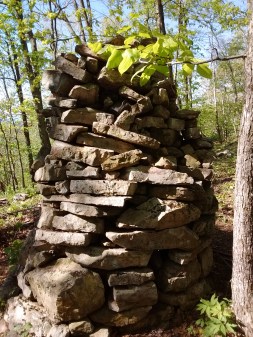
The trail continues, across a small field of tall grass, soaking our legs with early morning dew.  As we enter the trees on the other side of the field, our path begins ascending Sinking Creek Mountain, a steep 1,100 foot, two mile climb.  Ninety minutes later, the crest of the ridge brings us to a very wide, open, flat promontory with a cooling breeze to reward our efforts! Piles of flat, brick-sized rocks stacked neatly in circular piles, ranging from three to six feet in height, dot the top of the ridge.  What could they be for?  Do they mark a boundary of some kind?  Obviously man-made, they are a mystery!  The rock piles have old apple trees growing between.  Hmmm, is there a connection?  Perhaps this summit was farmed at one time?  My mind boggles at the thought of the amount of sheer physical work it took to clear and stack all these rocks, and plant a mountain top orchard.  I feel very small, just strolling along on this wide, level path, past evidence of the back-breaking struggle of early settlers!

IMG_20170516_094409866
Man made piles of rocks. What was the motivation?

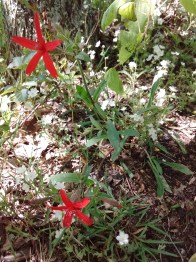
Flowers accent our walk.  Lily of the valley leaves are common, but the beautiful white bells are unusual enough to be notable.  Mayapples make small patches of green, with white and yellow blooms nodding underneath their canopies.  Unknown tiny white flowers, dotted with purple wild geraniums and scarlet fire pinks, create small banks of color.

IMG_20170516_110525733
Unknown white flowers and fire pinks.

The trail continues to climb gently.   I have been hearing the explosive rustle of squirrels deep in the undergrowth as they leap from tree to leaf-covered ground and back to another tree.  Now, as the ridge begins to narrow, I start to see them, and they put on quite a show.  One squirrel, gripping a fat acorn in his mouth, runs up a tree trunk, leaps to a leaning limb, misses his grip and slips, hanging upside down for a moment, then scrambles around, continuing upward.  Another squirrel bursts out of a bush, bounds over a log, and hurtles toward a vertical tree trunk, landing with an audible whump, spread-eagle, claws digging into the bark.  I watch as he visibly inhales, then clambers upward.

With the spine of the ridge narrowing, the trail follows along the western side of the mountain, stony slabs rising on top.  Suddenly, our path makes a ninety-degree right turn and disappears through a keyhole-shaped breach between two boulders.  We climb through, only to see … the other side of the mountain! This was so much fun for the trail builders, they do it several times, switching from one side of the ridge to another!

IMG_20170516_105513120
What do we see? Merely the other side of the mountain! But, oh, what fun!

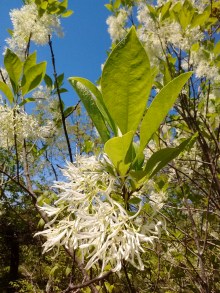
Just as legs are wondering if the trail will ever stop climbing, the trees open up, and there is a long, sweeping, rocky spine ahead.  For the first time, I realize that Sinking Creek Mountain is a geological anomaly.  Later, the internet tells me about the Pleistocene Ice Age, when enormous slabs of rock, up to 1.5 square miles in size, slid off the eastern side of this mountain, creating some of the largest known landslides in the world.  But for now, it is a happy scramble along bare rock, with sun beating down, cliffs dropping off, and more wonder than my soul can hold!  Blackberry vines curl over the edges of the ridge top.  An unknown flowering shrub flaunts large gobbets of white flowers.  Butterflies with wings of iridescent blue, black, and silver flit across the path.  A rufous-sided towhee calls out, and I stop, looking into the ridge-side tangle of greenery for his red sides and black back.

IMG_20170516_110120928

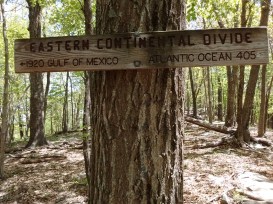
After a lovely scrabble over and around boulders and rock slabs, the northern end of the mountain ridge comes into sight.  A sign announces that this is the Eastern Continental Divide, with the Atlantic Ocean 405 miles to the east, the Gulf of Mexico 1,920 miles to the west.  Once again, I am overwhelmed with wonder.  To be told that I am standing upon the dividing line between two such awesome bodies of water!  This is an incredible world in which we live!

IMG_20170516_115127227

Here the trail drops off the ridge, taking switch backs through the trees and steep terrain.  Down we go, down, down, down.  Just as my knees begin to protest, Niday Shelter comes into view!  Oh hurray!  We have hiked for nine miles, and it’s time to stop for a late lunch!

Several thru-hikers have the same idea, and we spend a pleasant 45 minutes introducing ourselves to new hikers, chatting about the trail, other hikers, weather.   Shelters along the AT are good places to meet others, as people stop to use the picnic table, privy, or even the shelter itself.  Today, with sun beating down, we enjoy the shade of trees and the birdsong which punctuates our conversations.

Two miles further downhill, we come upon VA Rt. 621.  It’s time for you to leave me, returning to civilization with the help of a pre-arranged shuttle.  As a thru hiker, however, I’ve got several more hours of daylight, and a few more miles to hike.    The top of Brush Mountain is my goal for the day.  But, hey, since you are leaving this land of natural wonder, and returning to a more sophisticated life style, could you take my garbage with you?


Housekeeping

May 13, 2017

My sister informs me that I need to let friends know “the end of the story” of my collarbone.

“Oh no,” I protest.  “Surely everyone is sick of reading about that broken bone.”

My sister’s voice takes on a patient tone.  “People want to be reassured.  Are you truly all the way healed?  What’s happening with you?”

So, I’ve decided to do a bit of housekeeping, letting friends know what’s up in my life, and answering “behind the scenes” type questions about hiking the AT.

1.  Clavicle – I broke it six weeks ago.  Spent two weeks camping near the Dismal Swamp of North Carolina during the most fragile part of healing.  Then spent two weeks hiking in a sling, going slowly, grateful for Jay’s help.  Two weeks more of hiking without the sling, slowly regaining the use of my arm and shoulder.  Today I gave the sling to Goodwill.  Hurray!  Just a normal hiker now!

20170519_064240
I’ll be swinging from vines soon!

2.  Food – We resupply every four days, whenever we come near a store.  We don’t carry a stove, and we eat the same food three times per day, every hiking day.  This simplifies our life tremendously!  Other hikers do not eat like this.  Many carry stoves, and most seek variety.  However, being bored with our food has so far been impossible when hiking eight to ten hours per day.  Hunger is the best sauce!

What do we eat?  We eat a mostly paleo diet on the trail.  Sardines packed in olive oil, extra sharp cheddar cheese, dark chocolate, cashews or pumpkin seeds, and raisins.  We also sometimes carry one unusual item for a leg of the trip.  One week it was toasted coconut from my parents.  Once it was a bag of figs and dates from a hiker box.  A small bottle of home-made molasses from our friends, Alan and Mary, lasted five days.  Yum!

IMG_20170520_135406
Sardines, raisins, cheese, dark chocolate, pumpkin seeds, and one spoon! The ultimate hiking diet and utensil!  (This is enough food for one person for three days.)

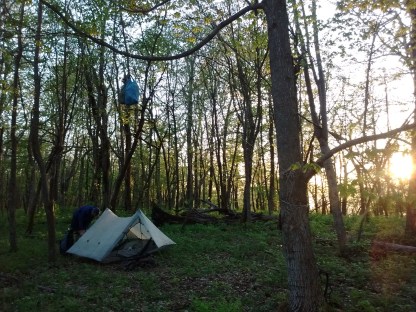
3.  Sleep – The Appalachian Trail has shelters about every eight miles.  These three-sided structures are used by many hikers.  We prefer the comfort of our tent, which is bug-free, rain proof, and private.  Every 100 miles, we stop in a town and stay at a hotel or a hiker hostel, doing laundry, getting a shower, and sleeping in a real bed.  Ahhh!

IMG_20170513_200113471
Home sweet home!

4.  Shoes – We hike in zero drop trail shoes, light weight and with no built up heel.  Our old shoes have now hiked nearly 700 miles of the AT, and more than 400  miles in Nevada.  They are done for!  Hurray for new shoes!

IMG_20170520_134232
These shoes are done with walking!