Over the Pyrenees!

May 15, 2019

At 9:00 a.m. of our second Camino day, our shuttle dropped us at the Statue de la Vierge de Biakorri, last seen yesterday afternoon. I gave the statue a little wave, whispering, “I’m so glad you watch over the shepherds in this beautiful alpine section of the earth.”
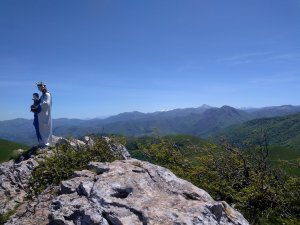
La Vierge de Biakorri

The sun kissed our hat brims as blue sky arched overhead. Cool breezes playfully slipped between jacket and neck. Amazing weather escorted us through the Pyrenees.

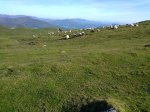
The track led past empty grass covered slopes with an occasional herd of sheep seen far away across the undulating green.

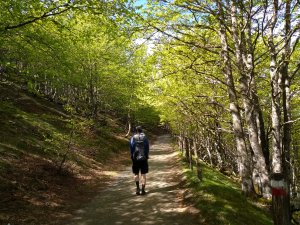
A couple hours of walking brought us to the edge of a stand of trees. Jay, consulting the guidebook, told me we would be hiking through the largest stand of beech trees in Europe. I took a picture of the beginning of this awesome forest.

Beech trees!

Our path followed ancient tracks used by shepherds and armies. As we entered the beech forest, our feet were cushioned by several inches of leaves. What a treat!
At Lepoeder Pass, we were rewarded with another outstanding view. Our path then took a steep plunge, dropping 1,500 feet of elevation in two miles.

Ronceveaux has welcomed pilgrims since the 12th century. The church and dormitories see tens of thousands of seekers each year.

First glimpse of the pilgrim haven of Ronceveaux.

When we arrived, the entryway was jammed with tired, dirty hikers. Two hundred pilgrims had crossed the Pyrenees on this beautiful day, and they all had hopes of renting a bed for their tired bodies. We were given a colored tag by harried volunteers, and told that we had about an hour’s wait until our color group was called. A sign on the wall summed up the situation in five languages: “Be calm. You will be helped.”

Eventually, eight euros each gave us beds for the night. Eight bunks (16 beds) crowded into our room, with barely enough space to squeeze between, especially while toting a pack. A bathroom with two toilets, two sinks, and two tiny shower stalls served about 40 people at our end of the building. Everything was sparkling clean, and I enjoyed my very fast shower!

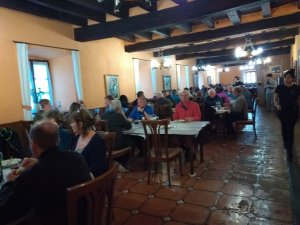
At 7:00 p.m. we went to another part of the complex for a pilgrim dinner (10 euros each). With dizzying efficiency, two hundred people were served a well cooked meal of zucchini soup, pasta with tomato sauce, fish, french fries, and cake for dessert. I took a picture of part of the room.
Following dinner, a special pilgrim mass was offered at the cathedral. Four priests presided, singing part of the ceremony with harmonious voices. I’m sad to say that I couldn’t understand any of the Spanish. Nevertheless, it was interesting to observe, and the cathedral was truly beautiful.

Though I was mentally prepared to sleep in a room full of strangers, the reality of so many bodies in such a small space made me wonder if I would ever fall asleep. Fortunately, exhaustion took over, and I knew nothing until morning. Not exactly a restful night, but certainly a good way to bring home the connection between our modern life and 12th century pilgrims.

Two nights, fifteen miles, and a mountain range made a good start to our Camino de Santiago adventure!

Into the Pyrenees!

May 13 – 14, 2019

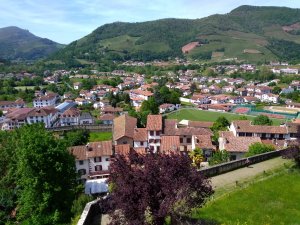
We arrived at St Jean Pied-du-Port via train early in the afternoon. Partially enclosed by medieval ramparts, the small town gives an overwhelming impression of red roofs and clean white walls with tidy red trim.

St Jean Pied-du-Port, France

We followed narrow cobbled streets to the Association les Amis du Chemin de Saint-Jacques (a.k.a. the Camino de Santiago Pilgrim Information Office!) A large crowd spilled out the office door, maybe thirty people, patiently waiting in a ragged line. Jay and I squeezed inside, set our packs against the wall, and joined the throng. All of us were “pilgrims”, seeking a “pilgrim passport” which would enable us to stay at municipal hostels for a small fee on the journey to Santiago de Compostela. In a variety of languages, five volunteers at a long table composedly gave information, treating each person with dignified excitement, seemingly happy to help this horde of clueless people begin their dream.

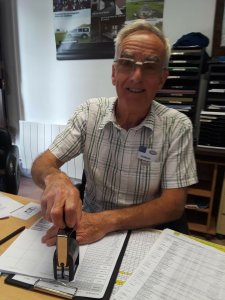
The man who assisted us spoke English, French, and Italian! He gave us our “passports”, cardboard brochures divided with grids of lines. He explained that we would get these documents stamped at each hostel, thereby proving that we had walked the whole Camino.

When we asked our helper for directions to the Gite Zazpiak, where we had made reservations on line, we learned to our surprise that the hostel was 1.5 kilometers out of town!

“You can easily walk there. Follow the yellow shells marking the Camino. You will make a jog across a major road, keep going, then turn left at the white building with red trim.” He paused to see if we appreciated his irony. ALL the buildings were white with red trim! “Don’t worry,” he reassured us. “There will be a sign. After you turn left, continue about half a kilometer. Your hostel will be the second white building with red trim!” With that, he stamped our pilgrim passport and sent us merrily on our way.

Our first pilgrim passport stamp!

******************************

Streamers of sunrise greeted us on our first day of walking. Happily, we ate “petit dejeuner” (coffee/tea, bread, jam) at our hostel, then set off, ready for adventure!

The guidebook suggested pilgrims should hike to Roncesvilles the first day, 15 miles away, over several passes through the Pyrenees Mountains. Though this is a reasonable length on the Appalachian Trail, I felt doubtful of my stamina, even with a light, ten pound, pack. Fortunately, Jay, following advice from former pilgrims in Seattle, had arranged a slack pack for our first two days.

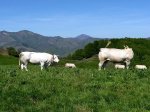
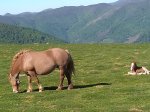
Our path followed very steep, tiny mountain roads, climbing 3,600 feet. Sheep, goats, cows, horses, pilgrims, and cars all shared the same route. The pilgrims were, by far, the most numerous and least predictable denizens of the road!

As we walked, we noticed cow bells ringing almost continuously in the clear mountain air. “It’s a Basque Bovine Bell Choir,” Jay joked. Later we realized sheep, goats, horses, and burros also wear bells.

We’d been hiking for a couple of hours when we came to a small cafe, the Fermé Ithurburia. It’s terrace invited us to stop for coffee/tea and a fabulous view. We also ate sardines and cheese, our staple trail food. Petit dejeuner had been a bit too petite for our walking appetites!

Terrace of the Fermé Ithurburia

We were lucky enough to see three Basque shepherds unloading a whole truckload of sheep. Later, the noisy herd passed us on the road. Yes, sheep, along with everyone else, can walk faster than me!

Our day of hiking ended at the Statue de la Vierge de Biakorri. This statue of the Virgin Mary is said to watch over shepherds and their flocks. From there, we caught our pre-arranged shuttle back to St Jean Pied-du-Port.

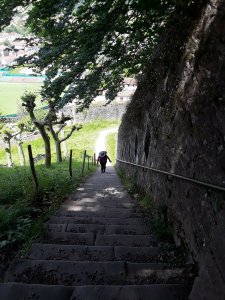
65 steep and uneven stone steps along the medieval wall led to the peak of St Jean Pied-du-Port.

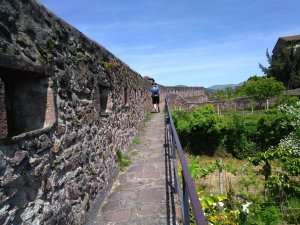
Jay walks past arrow slits in the wall.
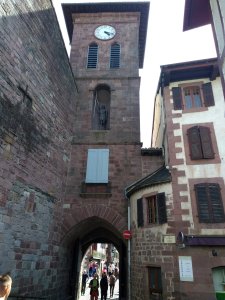
This gate in the town wall has another protector of the Basque countryside, the mythological Basajaun.

After exploring the medieval castle walls, we returned to the Gite Zazpiak where we were served an incredibly excellent meal cooked by a talented chef. Tomorrow the van will take us back to the Statue de la Vierge de Biakorri, and we’ll continue crossing the Pyrenees!

Here is a short video of of the Black-faced Manech sheep passing us today.

A New Adventure Dawns

May 11, 2019

As you start to walk out on the way, the way appears.

-Rumi

As spring exuberantly bounced into our lives, I knew Seattle winter hibernation was coming to a close.

Much as I longed to be on the trail again, my body wasn’t quite ready to carry a full pack. Jay, still dealing with emotions from the accident, couldn’t see sleeping in a tent yet. Obviously, we needed a new adventure.

We had often discussed hiking in Europe, and many friends had suggested that we hike the Camino de Santiago, a 500 mile pilgrimage from St. Jean Pied-du-Port in the French Pyrenees to Santiago de Compostela in Spain.

Jay’s uncle gave a piece of rare advice, “If you have a dream, the time to do it is now.”

First we spent some time with my family in Tennessee. It had been a year since we’d seen them. As we hiked the Maryville College woods, I gloried in the spring flowers!

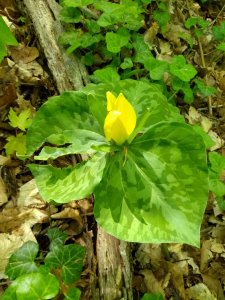
Trilliums captured the sunshine.

Now, here we are in Spain, getting ready for another pilgrimage. It’s been three weeks since I’ve practiced carrying a backpack. It will be interesting to see what it’s like to become a hiker again!

Here we are in Barcelona, on our way to hike the Camino de Santiago!